
Solutions, Not Services: Working Differently and the New AHP Framework
 By Kate Sheehan, Occupational Therapist
NHS England is developing a new national framework for Allied Health Professionals (AHPs) covering 2027 to 2032 and there is a consultation period out on it now. This matters because the next few years will bring continued change across the NHS and social care, including growing demand, workforce pressures, and a stronger focus on prevention, equity, and personalised care.
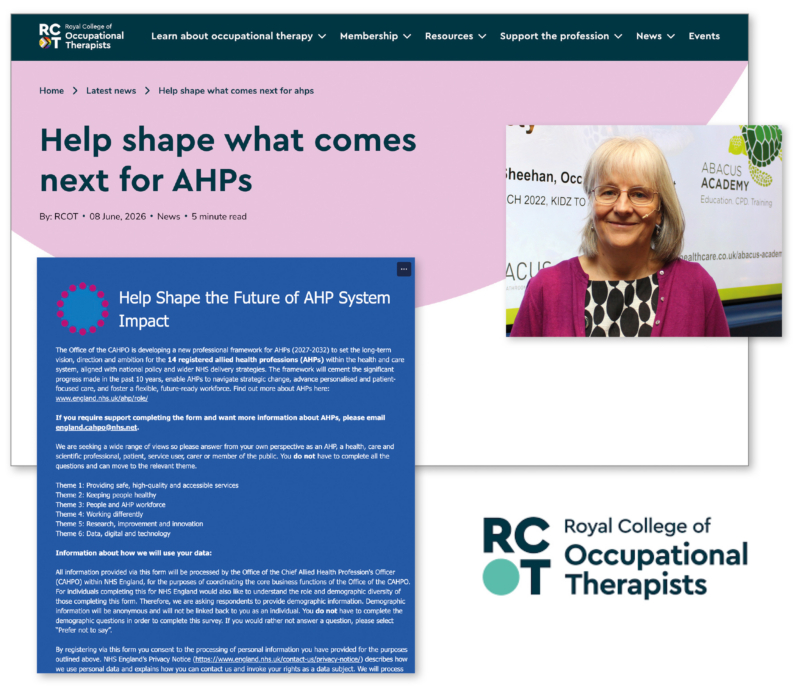
The new framework will guide how AHPs respond, including how services are designed, delivered and valued. For occupational therapists, that makes it worth paying attention to and responding to it. Every submission by an occupational therapist counts.
The consultation is organised around six themes:
- providing safe, high-quality and accessible services
- keeping people healthy through prevention, earlier intervention and reducing inequalities
- people and workforce, including skills, leadership and retention
- working differently across pathways, teams and settings
- research, improvement and innovation in everyday practice
- data, digital and technology, including how impact is captured and demonstrated
All six matter; however, the one I keep returning to is the fourth: working differently. It is also, I would argue, what stands between us and the second theme of prevention.
Working differently asks an uncomfortable question: what do people actually want when they come to us? I suspect very few arrive at the NHS or social care seeking occupational therapy. They come looking for a solution to a problem, an adaptation, a piece of equipment, a way to manage a daily task that has become difficult. And yet our instinct is often to lead with a full holistic assessment, to understand the whole person on our terms. There is a tension between that instinct and a strengths-based approach that starts from what matters to the person rather than what matters to us as a profession.
It is worth asking whether our current structures and services make this harder. A service built around a profession does not necessarily move someone closer to their solution. An occupational therapist might identify that an adaptation is needed, but the funding and the team that delivers it often sit somewhere else entirely, so the assessment becomes one more step rather than the answer. We have to be willing to ask whether the desire to protect professional identity sometimes slows people down. The braver position is to design services around the solutions people need, not around the professional they happen to see first.
This is where working differently and prevention meet. Real prevention means getting in earlier, before the fall, before the crisis, before the problem takes hold, which depends on where we are placed in the system: in primary care, in housing, in the conversations about adaptations and equipment that keep people safe and independent before anything goes wrong. But if our services are organised around professions and assessments, we stay reactive by design. We arrive after the event because that is where the system has positioned us.
None of this means giving up what occupational therapy does well. It means being clearer about when our skills add value and when we are adding a step. The framework is a chance to make that case for services built around people and their solutions, and for an occupational therapist who gets in earlier rather than later.
This consultation is an opportunity for occupational therapists to have a say about the role of occupational therapy and AHPs over the next 10 years.
More information about the framework and how to submit your feedback can be found on the Royal College of Occupational Therapists website.