
Bath, Shower or Both?
 By Kate Sheehan, Occupational Therapist
A bath, shower or both? The assumption is usually straightforward: a shower is more accessible than a bath. Look purely at physical effort, and a shower asks less of the body, with no lowering, no immersion, no getting back out from a seated position low to the ground. If we, as occupational therapists, are assessing on effort alone, a shower nearly always wins. But use, not just access, is what the legislation asks us to consider, and use tells a different story.

The Housing Grants, Construction and Regeneration Act funds “facilitating access… or providing… or facilitating the use” of a bath or shower. Neither access nor use is defined in law. Access is the more straightforward of the two: whether someone can physically get to, into, and out of the facility. It’s observable, and it’s the kind of barrier that shows up clearly on assessment. Use is harder, because it asks whether someone can actually carry out the activity once they’re there, and that’s a question that goes well beyond physical effort.
John Winfield’s account, published in the British Journal of Occupational Therapy over twenty years ago, illustrates this well. Winfield, who had cerebral palsy and used a powered wheelchair, designed his own bathroom adaptation with his wife without an occupational therapist involved. On physical need, they got it right: a level-access shower, the best available, suited exactly to his mobility. On use, it did not work at all. Winfield had spent his childhood and adolescence in institutions, where he suffered abuse, much of it in bathrooms, much of it in showers. He couldn’t explain this at the time; it took him ten years to find the words. In the meantime, he showered perhaps once a month and the toll on him and his family was severe. The shower met every physical criteria but it met none that actually mattered.
When Winfield was finally able to describe what showers meant to him, he sought advice from a home improvement agency, and this time an occupational therapist was involved. He credits that advice directly: the OT confirmed that the new plan they’d proposed was the only one that would work in the long term, and that confirmation was what made it possible for the family to commit to it. Winfield is candid elsewhere in the piece about what that professional input meant to him. Given the choice of having one professional involved in his life, he says he would choose an occupational therapist, and he describes the OTs who have supported him as skilled and visionary. Following the change, a bath with a hydraulic seat replaced the shower and he went from one shower a month to two or three baths a week. Nothing about his physical needs had changed. What changed was that the adaptation was finally built around use, not just access.
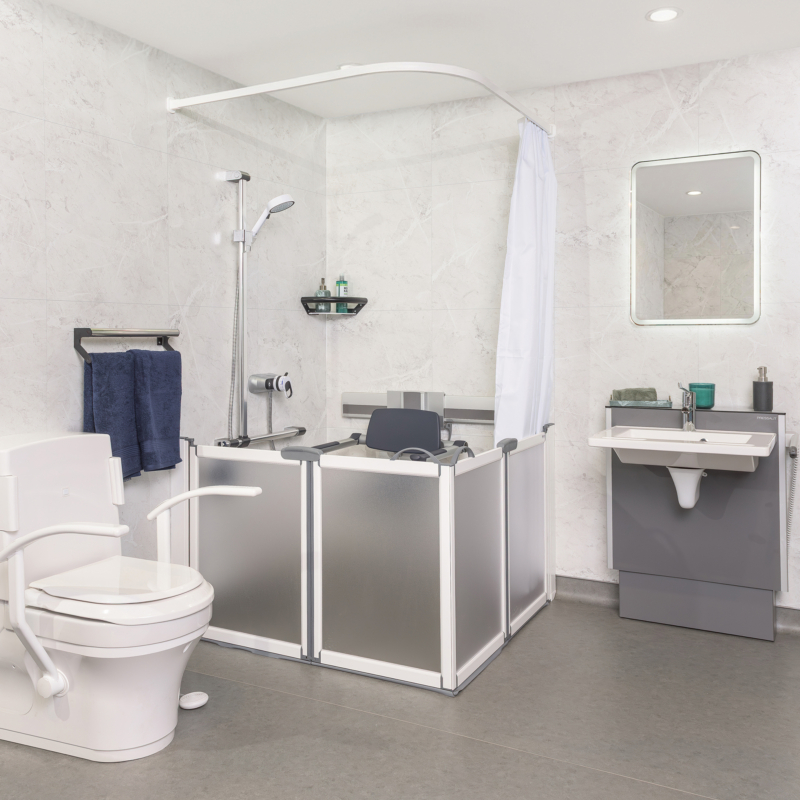
The same principle applies beyond sensory or trauma-related presentations. For some people, particularly those who cannot weight-bear safely or who have complex postural needs, a seated, supported bath with appropriate equipment can meet hygiene needs with less risk to the person and to carers than a shower transfer, even though the bath looks like the more demanding facility on paper.
Necessary and appropriate is the test that catches what a physical-needs checklist misses Foundations have developed a framework to support this kind of decision-making, and the key question within it is one about suitable alternatives: does the shower actually meet the need, safely and sustainably, or only appear to on paper? For Winfield, a shower was never a suitable alternative to a bath, whatever the physical assessment suggested, because it didn’t address the need that was actually driving his presentation. The same question applies to sensory processing needs, to certain moving and handling presentations, and to anyone for whom the more accessible option on paper turns out to be the one they cannot use.
A shower will often be the right answer. But “often” isn’t “always,” and the cases where it isn’t are exactly the ones a purely physical assessment is least equipped to catch. Winfield’s story is a reminder of what’s at stake when we get that wrong, and of why use has to sit alongside access as a genuine, first-order question, not an afterthought to it.
Further reading
Best Adaptation Redeeming People’s Homes: Enlightened Occupational Therapy